
Thirty Teams, Eleven Dialects
Clustering playtypes to decode how each offense speaks

Mapping the 2024-25 NBA’s Offensive DNA
You’ve probably seen that viral Kirk Goldsberry chart comparing the past and present: a sea of mid-range dots giving way to a rim-and-three-point archipelago. It’s a snapshot of what the modern NBA looks like from above.
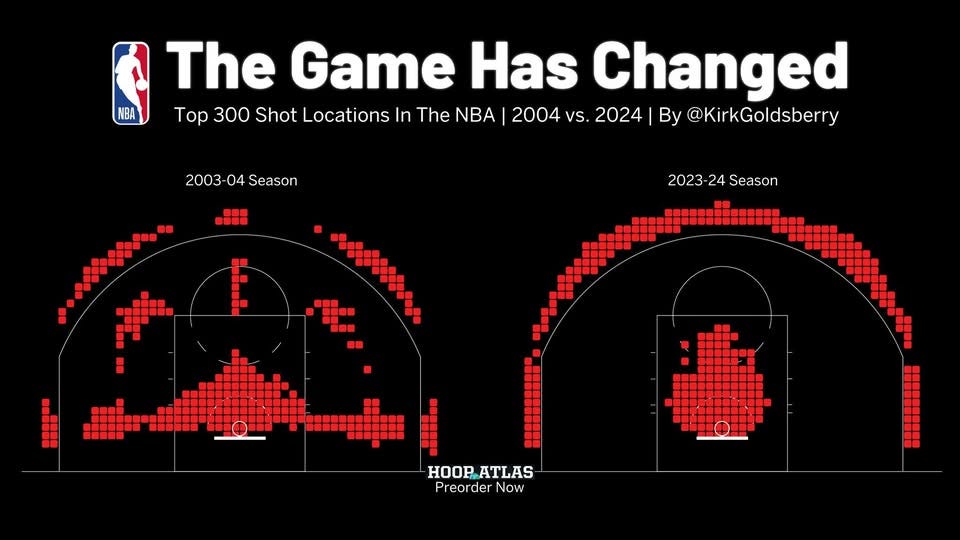
That image fuels the familiar refrain: every team plays the same now. Just spread the floor, run pick-and-roll, and spam threes. Even Steve Kerr has called today’s game “a little predictable,” and Gregg Popovich has long grumbled that the three-pointer turned basketball into “a circus.”
But if you only look at where shots end, you miss how teams get there. The league’s outcomes have converged, yet the paths to those outcomes remain remarkably diverse. Some teams grind through handoffs, some hammer the post, some crash the glass like it’s 1995, and some trust the first clean pull-up they see.
To capture those stylistic lanes, I scraped seven data tables from NBA.com’s team pages and merged them into a single feature set focused on offensive process: how possessions start, and how often clubs chase second chances. Outcomes like spot-ups or roll-man finishes are mostly downstream of those decisions, so they stay out of scope.
Advanced metrics (adv_): Offensive Rating, Assist %, True Shooting, Turnover %, Pace, and more.
Offensive rebounding (orebound_): OREB volume, contested boards, chances, chance %, adjusted chance %.
Play-type volume and efficiency (offense only):
Isolation (iso_)
Pick-and-Roll Ball Handler (bh_)
Post-ups (post_)
Handoffs (hoff_)
Transition (trans_)
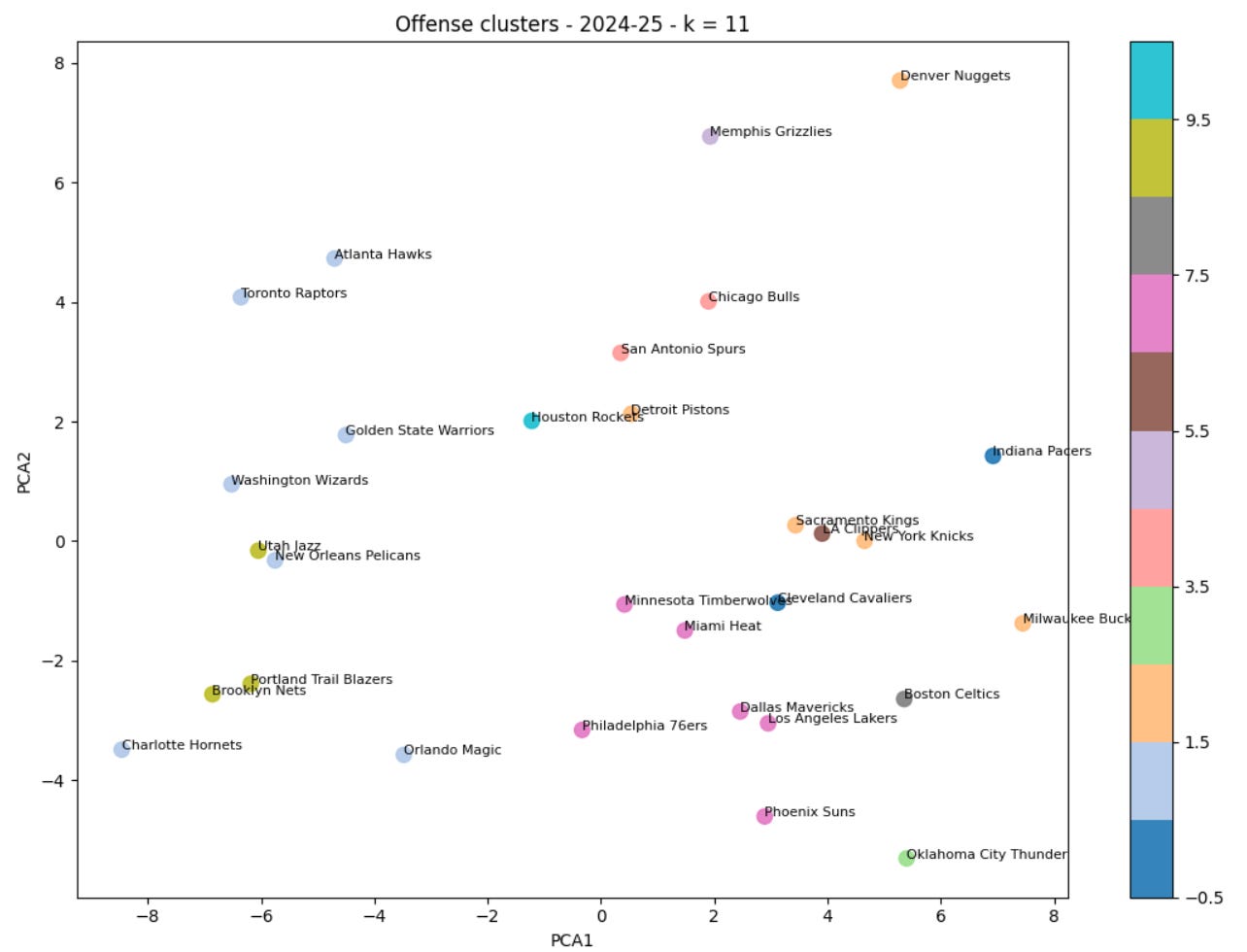
After standardizing the features, I ran K-Means to let the data cluster teams by offensive style. The result is a clear, data-driven map of how NBA teams actually attack: eleven distinct offensive archetypes for 2024-25.
Short version: the league’s surface looks uniform, but the underlying rhythm isn’t. The threes-and-PnR era is real, yet teams still compose those elements in wildly different ways. Some are string quartets, others are drum corps, and the data agrees.
Offensive Style Clusters
Using the data-driven clustering, we identified 11 broad offensive archetypes in the league. Each cluster groups teams that run offenses in similar ways. Below, we present each cluster with its member teams, a description of what makes their offense tick, and a few signature stats that highlight their style.
Surgical Spread PnR
Teams: Cleveland Cavaliers, Indiana Pacers
Think of the Cavs and Pacers as the league’s minimalist chefs: a short ingredient list of spacing plus pick-and-roll prepared perfectly. Guards live at the trigger, toggling between the pull-up, the pocket pass, and the spray to the slot. The first clean advantage becomes a shot or a kick. The ball does not boomerang, and it rarely turns into a live-ball mistake. They do not chase the offensive glass, which keeps the floor balanced and the transition defense set. They rarely iso you to death. The point is to create the edge early and convert it before help can load up. If you cough it up or miss long, they have enough transition pop to twist the knife.
Good video on the Cavs and their spacing:
What pops
PnR as the engine: Big lifts in ball handler usage and production (bh_FGA, bh_POSS, bh_FREQ%, bh_FGM, bh_PTS) with real payoff in bh_PPP, bh_EFG%, and bh_SCORE FREQ%. Ball handler turnovers stay low.
Efficiency from discipline: Assist to turnover and assist ratio rise. Team turnover rate falls. Shooting lifts show up in eFG% and TS%.
The post is an opportunistic lane, not a hub. Think slip seals, early duck-ins and matchup wins that appear naturally. Efficiency follows, with stronger post PPP, EFG% and FG% and fewer giveaways.
Lean DHOs with solid yield: Handoff efficiency ticks up on modest volume. A change up instead of a staple.
Transition as seasoning: Better transition PPP and EFG% with fewer mistakes, plus enough makes to punish errors.
Let the floor breathe: Offensive rebounding rate and OREB activity stay low to preserve spacing and matchup flow.
What it looks like on film
Early edge, simple reads: High screen, defender trails, and it is a pocket pass or a two dribble pull up. If the low man tags, it becomes a quick spray three. No over dribble and no hero passes.
Empty corners and lifted bigs: Corners empty or bigs lift to flatten help. The weak side big plays connector more than crasher.
Next action, not bailout: If the initial gap closes, they flow into a quick DHO or reversal. New read tree from a fresh angle.
One line summary: Cleveland and Indiana win possessions with first action clarity, high return PnR, tidy decisions, selective counters, and almost no appetite for chaos on the offensive glass.
Handoff Treadmill, Crash Insurance
Teams: Atlanta Hawks, Charlotte Hornets, Golden State Warriors, New Orleans Pelicans, Orlando Magic, Toronto Raptors, Washington Wizards
These offenses lean on dribble handoffs to open possessions, but the payoff lags. The ball circles the elbows and slots, the handoff happens, and too often the next touch is a tough pull-up or a congested drive. Isolation and ball-handler pick-and-roll do not rescue the trip, so points come from volume rather than clean looks. To keep the scoreboard moving, these teams press the offensive glass and nudge the pace, accepting a little sloppiness along the way. The post game is light and not especially rewarding, and the overall shotmaking trails the league.
What pops
Handoffs not cashing: Efficiency slides on DHOs (PPP, score rate, eFG%, FG%, percentile) even as DHO volume and touches tick up.
Shotmaking drag elsewhere: Cluster-wide dips in adv eFG% and TS%; iso and PnR-ball-handler efficiency both down across PPP, eFG%, FG%, and score rate.
Transition payoff muted: Lower trans PPP, eFG%, and score rate despite a small bump in frequency.
Turnovers creep up: Team TOV% rises, with extra mistakes in DHOs, transition, and a bit from the ball handler.
Glass as a lifeline: Offensive rebounding becomes Plan B; OREB rate, chances, and contested wins all climb.
Post and stripe are not fixes: Post efficiency metrics sag across the board, with only a small uptick in post free-throw draw.
A touch more pace and pass volume: Pace and AST% edge up, though AST Ratio slips, reflecting more actions without cleaner advantages.
What it looks like on film
Elbow-to-wing handoffs that stall: Big stationed at the elbow, guard loops into the DHO, and the catch flows into a defended pull-up or a pick-up dribble.
Crowded lanes after the exchange: Weak-side help is already set, so curls and keep-dribbles run into bodies; the kickout arrives late in the clock.
Bailouts invite risk: Extra dribbles post-handoff bring digs and strips, or rushed drives that flatten efficiency.
Crash on contact: On misses, wings and guards dive for tips and second chances. The first shot is often the setup; the putback is the goal.
One-line summary: High DHO volume without the payoff, pace and boards as insurance, and efficiency that leaks across iso, PnR, and transition.
Paint-First Balance
Teams: Denver Nuggets, Detroit Pistons, Milwaukee Bucks, New York Knicks, Sacramento Kings
These offenses start in the paint. The first touch comes at the block, the nail, or off a forceful drive that gets two feet in. Help shifts, the reads get simple, and the next action flows. It is not throw it in and wait. It is inside touch, quick decision, and then the support pieces do their work: clean pick and roll reads, purposeful handoffs, and a measured dose of transition. Turnovers stay low, the shooting holds up, and there is little appetite for chasing the offensive glass.
What pops
Inside as the first touch: clear lifts in post volume and production
(post FGA, FGM, POSS, FREQ%, PTS up with strong post FG%, EFG%, PPP, and Percentile; post TOV FREQ% down).Handoffs that matter: volume shows up and the yield is real
(hoff FGA, POSS, FGM, PTS up along with hoff PPP, SCORE FREQ%, Percentile; hoff TOV FREQ% down).Selective pick and roll, sharp returns: ball-handler volume is a bit lower, efficiency is higher
(bh FG%, EFG%, PPP, SCORE FREQ%, Percentile up; bh TOV FREQ% down).Open-floor efficiency without forcing pace: better transition FG%, EFG%, And-One rate, SCORE FREQ%, and PPP on modest volume.
Clean possession game and shooting lift: team TOV% down, AST/TO and AST Ratio up, eFG% and TS% up.
Second chances are not the plan: offensive rebounding emphasis is modest.
What it looks like on film
Early paint touch: entry to the block or nail, or a hard drive that draws the crowd. Then it is a cutter, a drift pass, or a kick into a handoff.
Elbow and slot DHOs: big at the elbow, guard takes the handoff into space, one or two reads, then a shot. The handoff is a feature, not window dressing.
Pick and roll by choice, not habit: screen when the matchup invites it. Short roll, pocket pass, or pull-up appears because the first edge was created inside.
Run when it is there, set when it is not: transition chances are taken, then it resets to the paint touch.
One-line summary: Start in the paint to bend help, then finish with handoffs, selective pick and roll, and measured transition, with low mistakes, steady shooting, and minimal interest in the offensive glass.
Shai-and-Space Control
Teams: Oklahoma City Thunder
This is star gravity as a system. The Thunder clear the floor, give Shai room to probe, and let his drives force a foul or create a clean look. Isolation and ball-handler pick and roll both cash at high rates, and the ball stays safe. The offense does not chase the offensive glass and it does not lean on post touches. It wins with foul pressure, on-ball efficiency, and tidy transition finishing.
What pops
Iso as a weapon: iso frequency, attempts, makes, score rate, and points all up, with strong iso PPP and shooting. Iso turnovers are down.
Foul pressure from the handler: ball-handler free-throw rate and shooting-foul rate way up. And-one rate is up.
Handler efficiency without bloat: bh FG%, EFG%, PPP, SCORE FREQ%, and Percentile up on moderate volume. bh turnovers down.
Clean possession game: team turnover rate among the lowest in the league. Transition turnovers are also low. Assist rate is lower, but AST/TO is high.
Transition polish: percentile, PPP, score rate, and made buckets up, on reasonable volume.
No appetite for second chances or post play: offensive rebounding metrics down across the board. Post volume and post efficiency down.
What it looks like on film
Clear a side, attack a seam: high spread, one gap, Shai gets two feet in the paint, then pull-up, euro finish, or foul draw.
PnR as a paint touch, not a maze: simple angle screen to shift the first helper, then rise for the midrange or hit the short roll.
Minimal risk, maximum control: few cross-court tries, few live-ball errors. If the window is not there, it resets quickly.
Selective change-ups: occasional DHO to vary the entry, but the drive remains the core. The bigs do not crash. They space or sprint back.
One-line summary: OKC runs on Shai’s drive game and whistle gravity, pairing elite iso and ball-handler efficiency with ultra-low turnovers, light handoff and post usage, and almost no offensive glass.
Run and Connect
Teams: Chicago Bulls, San Antonio Spurs
These offenses want the game in motion. They push the ball, pass early, and hunt numbers before the defense is set. In the half court they keep the ball moving with simple connections rather than grinding through a post hub or heavy ball-handler pick and roll. Post touches and post free throws are not a priority. The identity is pace, passing, and clean looks in the open floor.
What pops
Live in transition: big lifts in transition frequency, attempts, possessions, makes, and points. Efficiency holds up too with better transition PPP, EFG%, and percentile, plus more and-ones and fewer transition turnovers.
Play fast and share it: pace, assist percentage, assist ratio, and total possessions are all up.
Handoffs as early offense: handoff foul rates are up and handoff makes show up, but overall handoff efficiency is mixed and turnovers on DHOs are higher.
Iso used sparingly but cleanly: lower isolation volume, yet better iso percentile, PPP, FG%, and score rate. Iso turnovers are down.
PnR ball handler not the hub: lower BH volume and mixed BH efficiency, with BH turnovers higher than average.
Inside game is a light touch: post volume and post PPP are down, along with post score rate and post fouls drawn. Post FG% and EFG% tick up on select touches, but post turnovers rise.
Do not crash: offensive rebounding rate and raw OREB counts are down. OREB chance percentages look good when they go, but it is not a core plan.
What it looks like on film
Push and spray: hit-ahead passes, wings wide, quick extra to the corner or a lane touch for a dump-off.
Early-clock actions: drag screens and DHOs to keep the ball moving, then take the first clean look.
Selective isolation: one-on-one only when a mismatch is obvious, not as a steady diet.
Skip the heavy post diet: seals and duck-ins are opportunistic, then it flows back to pace and pass.
One-line summary: Run first and pass early, keep post usage light, and win the possession with tempo, connection, and efficient transition play.
Beale Street Stampede
Teams: Memphis Grizzlies
This offense is its own thing. Memphis wants the game in the open floor, then it hammers you inside. Ball screens take a back seat. The playbook leans on speed, early attacks, post power, and second chances. It looks different by design. If you want a quick primer on how the Grizz ran so little ball screen action, check out a breakdown of the Memphis offense here.
What pops
Transition on tap: huge lifts in transition frequency, attempts, possessions, makes, and points. Efficiency travels too with better transition PPP, EFG%, and overall percentile, plus more and-ones and fewer transition turnovers.
Ball screens are not the plan: big drops in ball-handler frequency, attempts, makes, points, and possessions. Efficiency is mixed to below average and ball-handler turnovers are higher than average.
Real inside punch: post game produces across the board. Post FG%, EFG%, PPP, score rate, shooting-foul rate, and and-one rate climb. Post turnovers fall.
Crash for extra bites: offensive rebounding rate, OREB counts, chances, and deferred chances are all up.
Handoffs as a change-up: volume is light, but handoff EFG%, FG%, PPP, and percentile improve while handoff turnovers drop.
Pace and pressure: pace and total possessions surge. Team turnover rate rises with the tempo, but shooting lifts show up in eFG% and TS%.
What it looks like on film
Run, then punish: push on the catch, attack a tilted floor, and finish before help organizes. Misses turn into quick putbacks.
Early post seals and duck-ins: sprint to position, catch deep, one strong move, or a quick kick to keep the edge.
Screen less, hit gaps more: instead of a steady diet of high PnR, the first action is a push, a post touch, or a handoff wrinkle to keep defenses guessing.
Relentless on the glass: wings and bigs fly in for tips and extra possessions while the weak-side spacer drifts to the arc.
One-line summary: Memphis sprints first and pounds second, with minimal ball screens, a heavy transition diet, a productive inside game, and real pressure on the offensive glass.
Half-Court Iso and Post Clockwork
Teams: LA Clippers
This is a slow, star-led half court machine. The Clippers put real weight on isolation and a reliable inside touch, then keep everything else simple. Pace is measured, passing volume is modest, and handoffs or transition show up as change-ups rather than pillars. A lot of the diet comes from a creator on the perimeter and a finisher inside. In practice that often looks like Harden organizing the floor on the outside and Zubac anchoring as a high-efficiency post scorer.
What pops
Isolation as a pillar: iso frequency, possessions, attempts, makes, points, and foul rates are all way up. Iso PPP and overall iso percentile are comfortably above average.
Efficient inside touch: post FG%, EFG%, PPP, score rate, and percentile are all up with healthy post volume.
Measured tempo, modest table setting: pace, possessions, AST%, AST/TO, and AST Ratio sit below league norms while TS% and eFG% trend up.
Handoffs and transition are tertiary: handoff scoring and foul rates can pop, but volume is lighter and and-one rate is low. Transition volume and impact are limited.
Selective glass work: offensive rebounding rate and raw OREBs are down even if contested share looks fine.
What it looks like on film
Harden maps the floor: empty a side, call for a clear angle, get to the pull-up or drive, or flow into a simple hit to the post. Few wasted passes.
Zubac as the anchor: early seal, deep catch, one move to the middle or quick baseline turn. If help comes, the kick is straightforward.
Live in the mid-clock: walk it up, get the matchup, then iso or feed the block. If the first look is covered, they recycle to a DHO or a second post touch.
Keep it clean, keep it slow: fast breaks are taken only when obvious. Most possessions are about getting to the star action and trusting shotmaking.
One-line summary: The Clippers play a deliberate, star-centric game that leans on isolation and a dependable post target, with Harden steering on the perimeter and Zubac finishing inside while handoffs and transition stay in the background.
Half-Court Shotmaking Collective
Teams: Dallas Mavericks, Los Angeles Lakers, Miami Heat, Minnesota Timberwolves, Philadelphia 76ers, Phoenix Suns
These groups prefer a slow burn. They walk you into the half court, clear a side, and let stars win one-on-one or out of simple two-man actions. They do not push often. They do not crash often. Possessions are calmer, built on tough makes and late-clock creation. Passing volume is lighter, but the shotmaking is real.
What pops
Iso leads the dance: higher iso frequency, attempts, makes, points, PPP, EFG%, and score rate. Percentile grading trends above average.
Low throttle game: pace and total possessions sit below league norms. Transition frequency, attempts, makes, points, and overall volume are down.
Selective run, solid finish: when they do run, transition efficiency holds up with better FG%, EFG%, FT and SF rates, and PPP on modest volume.
PnR as support, not a hub: ball-handler efficiency nudges up, but volume is modest and table setting is lighter.
Little interest in the glass: offensive rebounding rate and OREB counts are down, including contested boards and chances.
Inside touches are not a focus: post efficiency and score rate are generally lower, with only small pockets of fouls drawn.
Shotmaking steadies the numbers: eFG% and TS% trend up despite fewer assisted makes and slightly lower assist metrics.
What it looks like on film
Walk it up, pick a spot: star brings it across, calls for space, works into a pull-up or drive, or plays two-man with a screen and a counter.
One clean read: simple pocket pass, short roll, or kickout if help commits. If not, the star goes into shotmaking mode.
Clock comfort: no rush to the first look. They will probe, back it out, and take the best shot at eight seconds.
Stay home on misses: wings get back. No extra bodies at the rim hunting boards.
One-line summary: Slow pace, low crash, and little running, with offenses built to win in the half court through star shotmaking and steady, selective reads.
Five-Out Squeeze
Teams: Boston Celtics
Boston is the league’s purest spacing test. Most trips feature four or five shooters, the floor stretched to the walls, and a calm hunt for the best one-on-one or inside touch. The tempo is slow, the ball is protected, and the first side of the floor is often enough because the defense is already bent by the threat of all that shooting. They live in the half court, keep transition to a minimum, and let star creators work from wide runways. When they do go inside, it is on their terms and without sloppy finishes.
What pops
Methodical pace and control: pace and total possessions sit well below league norms. Team turnover rate is way down and isolation turnovers are rare. Assist percentage is lower, yet assist to turnover shines because they simply do not give the ball away.
Iso and interior touches as co-engines: isolation volume and production climb across attempts, makes, points, and frequency. Post volume is high with strong returns in points, PPP, score rate, and very few post turnovers.
Efficient pick and roll as a tool, not a crutch: ball handler EFG, PPP, and percentile are up even with lighter volume. They use it to trigger an advantage, then take the clean look.
Handoffs are selective but sharp: DHO efficiency grades out well while overall DHO volume, attempts, and makes are muted.
Almost no transition dependence: transition frequency, attempts, makes, points, and foul generation are all down. They prefer the half court where spacing and matchups rule.
Shotmaking holds up: team eFG and TS tilt above average because spacing turns tough shots into manageable ones and creators get to their spots.
What it looks like on film
Five-out spacing to start: both corners filled, wings lifted, a big stationed at the arc or clearing. The paint is empty until the drive or post seal appears.
Clean first option: a star attacks a tilted gap, gets to the pull-up or rim, or feeds a deep post catch. Help is late because every help step concedes a three.
Low-risk sequencing: if the first look is covered, they reroute to a simple re-screen or a DHO. No extra passes just to pass. No forced throws through traffic.
Walk-up rhythm: they will live in the half court and trust their shooters and shotmakers to outlast you.
One-line summary: Boston squeezes defenses with five-out spacing, star-led isolation and purposeful post touches, winning a slow possession game through ball security and efficient half-court shot creation.
Scrap-Heap Offense
Teams: Brooklyn Nets, Portland Trail Blazers, Utah Jazz
This group tries to win the possession by sheer volume. They churn through a lot of handoffs, send bodies to the glass, and hope extra bites at the apple cover for choppy first looks. The tradeoff shows up fast. Turnovers stack up, post touches do not pay, and the open-floor returns are thin. You still see some whistle hunting, but the overall shot diet tilts toward tough ones.
What pops
Giveaways are the tax: team turnover rate is high, with spikes in handoff turnovers and even in transition. Assist to turnover sits near the bottom.
Post as a dead end: post volume and production lag across the board, from field goal percentage to points per possession and score rate.
Fast breaks without the payoff: transition efficiency trails the league in PPP, effective field goal percentage, and scoring rate.
Live on the glass: offensive rebounding volume is up, including contested boards and total chances, creating second-chance lifelines.
Free throws with asterisks: handoffs draw fouls and isolation FT rate climbs, but iso efficiency and score rate stay below average.
Shot quality drag: team eFG and TS land on the low side, and ball-handler creation metrics lag across accuracy, scoring rate, and value.
What it looks like on film
DHO chains that stall: two or three handoffs to shake something loose, then a pressured pull-up or a late clock drive into traffic.
Bigs crashing from the dunker: weak-side big sprints to the rim on misses, hunting putbacks and kickout threes after the scramble.
Risky outlets, messy breaks: quick outlets turn into rushed decisions and run-outs the other way when the handle is loose.
Post touches as last resort: late seals and crowded catches lead to strips, off-balance hooks, and few clean layups.
One-line summary: These are volume offenses that bet on extra possessions from the glass, but the cost is real: turnovers, thin post returns, and transition trips that rarely cash.
Second-Chance Foundry
Team: Houston Rockets
Houston’s identity is built on volume at the rim and volume on the glass. They manufacture points with size and persistence: throw it inside, shoot it, then overwhelm the paint for the rebound. It is less about table-setting and pretty passes, more about repeating high-percentage looks until something gives. The pace stays measured, the assist counts stay low, and the post is a feature, not a bailout.
What pops
The O-glass is the engine: monster numbers across contested offensive rebounds, overall OREB rate, and total OREB chances. Second chances are not a bonus; they are the plan.
Real inside returns: heavy post volume with strong efficiency across FG%, eFG%, points per possession, and score rate. Turnovers on the block stay relatively tame.
Low table-setting: assist percentage and assist ratio sit near the bottom. This is create-it, take-it, or board-it basketball.
Half-court security over flair: overall team turnovers track a bit below average and ball-handler turnover rate is low, even as the pass count stays down.
Shotmaking is just okay: team eFG and TS trail league norms, so they make up the gap with volume at the rim and repeat attempts.
Not built for the break: transition volume and efficiency are muted, with some sloppiness on those trips.
Perimeter creation is secondary: some ball-handler volume appears, but efficiency lags, and isolation returns sit below average.
What it looks like on film
Pound, catch, finish, chase: deep seals and strong-side post touches flow into quick hooks or power finishes, followed by immediate crash from both the dunker and the slot.
Two on the ball equals a shot, not a swing: when help comes, the first counter is often a quick attempt before the defense resets, trusting the second chance if it misses.
Edges from brute force: fewer intricate actions, more wedge screens, duck-ins, and early rim runs to pin a defender and control the glass.
Short passing menu: inside-out kickouts show up, but only after the initial inside look is denied; the goal is to keep the ball close to the rim.
One-line summary: Houston wins possessions with muscle and repetition, turning the paint and the offensive glass into a production line for points.
Wrapping Up
If you zoom out, the league is not one note. Yes, spacing and pick-and-roll define the era. The clusters show that teams still arrange those ingredients in very different ways. Some lean on crisp ball-handler creation. Some live off the glass. Some run through the post. Some try to win in the open floor. The paths are varied, even when the shot map at the end looks similar.
Treat these clusters as a starting point, not a verdict. The inputs are team-level and fairly blunt:
We focus on how possessions start and how often teams chase second chances. Spot-ups and roll-man outcomes are mostly downstream and not included.
One season can be a bit noisy. Injuries, trades, and schedule pockets can tilt profiles.
Play-type tagging is imperfect. A few possessions in either direction can nudge a team across a boundary.
K-Means forces hard lines where the real world is fuzzy. Styles bleed into each other.
Context is missing. Opponent schemes, lineup combinations, and who is actually on the floor matter a lot.
Where this can go next:
Blend multiple seasons to smooth noise and track coaching shifts.
Bring in tracking data: touches, seconds per touch, dribbles per touch, pass networks, spacing proxies.
Separate half-court from transition more cleanly.
Run sensitivity checks with different clustering methods and feature sets.
Think of this as a map, not the terrain. It helps us see patterns, ask better questions, and spot the outliers worth a closer look. If you have ideas or disagreements, drop them in the comments. I will keep iterating as new data arrives and the season evolves.
🔥🔥🔥
Great stuff! How is the graph (axes) supposed to be interpreted?